Cesare Vecellio

A small post in the form of an artist’s biography as a teaser for the main post I will be releasing towards the end of this month! Spotlighting an artist who, in my opinion, is underrated in the canon of Italian Renaissance Art – Cesare Vecellio.

One of the most famous attributes of Cesare Vecellio is that he is a younger, second cousin of one of the most accomplished Italian Renaissance artists to come out of Venice, Tiziano Vecellio, otherwise known as Titian (or just Tiziano).

The Vecellio family came from Pieve di Cadore, a municipality in the Belluno region of the Veneto, and the birthplace of both Cesare and Titian. Not much is known of Cesare Vecellio’s life or artistic career, certainly not when compared to the wealth of biographical knowledge about the Venetian greats: Titian, Tintoretto, and Veronese (who will all be the subjects of various posts in the future). Cesare possibly studied painting with Titian’s brother, Francesco Vecellio. He is thought to have joined the workshop of Titian himself sometime before 1548. By 1570, Cesare was no longer working in Titian’s workshop and was instead working primarily as a publisher, although paintings attributed to him, including portraits, are dated post-1570. Presumably, Cesare went to Venice to work in his cousin’s workshop, but it is unknown exactly when he arrived in La Serenissima. A significant event that is known in Cesare’s life is that he accompanied Titian on the older artist’s trip to Augsburg in 1548. Who knows what artistic influences Cesare Vecellio was exposed to during that time? Ultimately, this does not provide any further assistance in trying to identify painted works by Cesare. Some narrative works exist in churches around the Veneto that are considered indisputably to be the work of Cesare. A handful of portraits have been attributed to him, including one that will be the subject of my main post at the end of this month. He also published and drew the illustrations for several books, but the most notable, first published in 1590, was De gli habiti antichi et moderni di diverse parti del mondo. It had 420 woodcuts, most likely drawn by Cesare but printed by another artist, and followed up in 1598 with a second edition that had some 500 woodcuts. Both editions are still considered important artefacts in the study of the history of fashion and how different fashions were perceived in the Renaissance. Much of the scholarship on Cesare Vecellio has focused primarily on his costume and lace pattern books, but especially the two editions on the ancient and modern dress of the world, published in 1590 and 1598. Vecellio died in Venice in 1601.
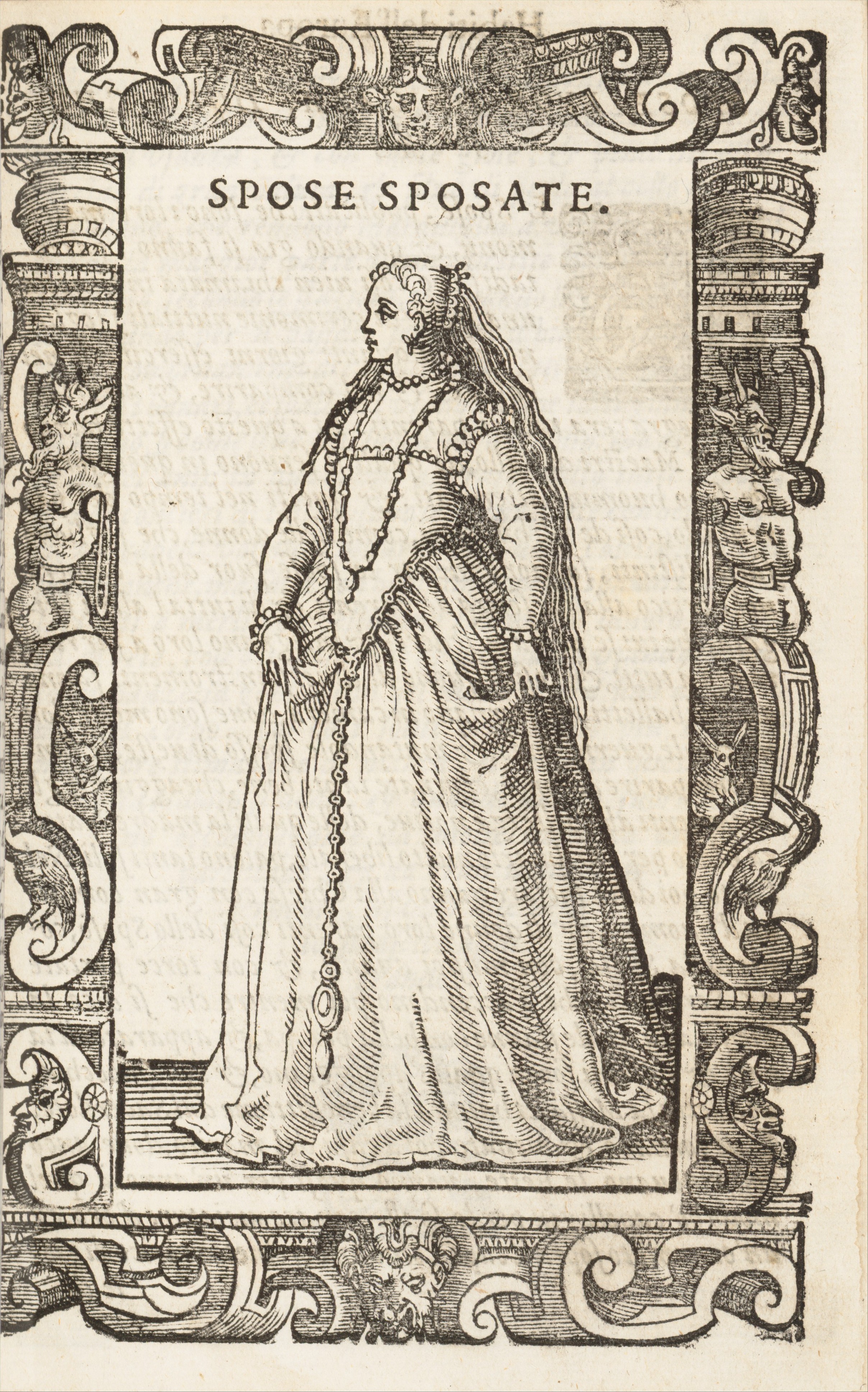
Image in the public domain. Page from De gli habiti antichi et moderni di diverse parti del mondo.
The above are the facts that exist (thus far, more could always be discovered in various archival sources) about Cesare Vecellio’s life. Some suppositions can be made based on these facts. He, like most other Venetian artists, probably created paintings on commission for families both in mainland Venetian territories and within the city of Venice itself. He most likely completed painted commissions outside of the workshop of Titian after he left. He was probably greatly influenced artistically by the works of Titian, but he most likely had his own artistic approach as well. Why leave his cousin’s workshop and continue painting, rather than just relying on publishing which was a lucrative craft in Renaissance Venice, if he was not also interested in continuing to be a painter in his own right? The lack of a significant number of surviving or attributed painted works does not mean he did not complete a greater number of painted works.

Next week’s blog post will be an object biography of Vecellio’s most famous costume books (both editions), and the main event at the end of this month will be an extensive, visual analysis of one of Cesare Vecellio’s (attributed) portraits, and also seek to explore some of the questions raised above.

Have any thoughts on this post, or Cesare Vecellio and his life & works? Please comment!

Sources:
Giorgio Reolon. Cesare Vecellio. La pubblicazione e stata realizzata. 2021
Cesare Vecellio. Vecellio’s Renaissance Costume Book: All 500 Woodcut Illustrations from the Famous Sixteenth-Century Compendium of World Costume by Cesare Vecellio. Dover Pubblications, Inc. 1977.
Eugenia Paulicelli. Writing Fashion in Early Modern Italy: From Sprezzatura to Satire. Routledge. 2016
https://www.themorgan.org/exhibitions/online/Renaissance-Venice/Cesare-Vecellio
https://www.metmuseum.org/art/collection/search/358319
New series: Object biography

The professor of a museum studies class I took during my Master’s taught us we can “ask” the same kinds of questions about objects as we would if we were interviewing people, and this can be a good way to discover the history of an object and how its use, perception, and significance has changed over time. I still use this any time I have to write about paintings and objects and I am applying it now to the portraits I am using as case studies for my dissertation. I won’t be talking about those portraits in this post, but I thought I would start an Object Biography series where once a month I do a deep dive into different kinds of objects (especially decorative art objects). So, you will be getting TWO posts a month (that’s the plan anyway. Except for October. I love Halloween and I have some big plans for this blog during October).

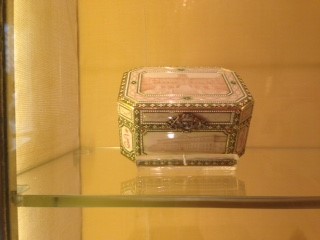
This post is based on the object biography I wrote for that class. The object I chose was one I was able to see in person at the Hillwood Museum, Estate & Gardens – the Iusupov music box (pink music box).

[All images were taken by me when I visited Hillwood].

Full view of the Iusupov (pink) music box, 1907, Hillwood House Museum. Photo by me

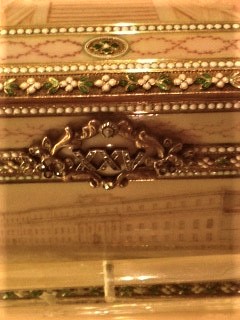
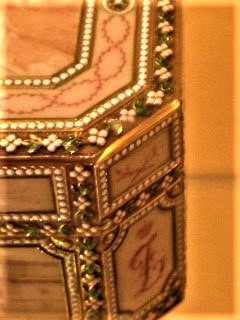
The Iusupov Music box was made in Russia at the Fabergé Jewelry company by one of their head craftsmen, Heinrich Wigström, around 1907. There are six main panels, one on each of the four sides as well as the lid and the base. There are two corner panels on the front of the box, featuring the letters F and Z, respectively, and two similar panels on the back featuring the letters F and N. Each panel on the box is made of enamel, done up in pinkish sepia tones. Gold banding, decorated with either a white and green enamel flower pattern, or a white enamel beading pattern, separates each panel. Each of the main six panels displays a different palace, and there are other, smaller panels featuring variations of a decorative branch pattern. The thumbpiece of the box is fashioned into the Roman numerals XXV (twenty-five), made of gold with tiny diamonds and two very small rubies on the center of gold flowers, one on either side of the thumbpiece. 

Detail of side panel with initial ‘Z’. Photo by me.
Detail of thumbpiece. Photo by me.

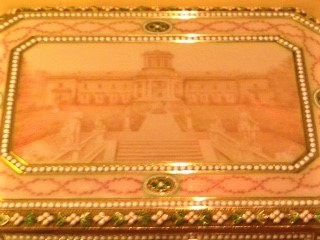
It was commissioned by Feliks and Nikolai Iusupov (the F and N from one set of corner panels) for the twenty-fifth wedding anniversary of their parents, Prince Feliks and Princess Zinaida Iusupov (the F and Z from the other set of corner panels). The box plays “The White Lady” by François Boieldieu which was the march of Prince Feliks Iusupov’s regiment, the Imperial Horse Guards (Garde à Cheval). The six palaces represented on the box all belonged to the Iusupov family. The front panel shows their palace on the Moika in St. Petersburg (this palace would later become the scene of the murder of Grigori Rasputin in which Feliks Iusupov the younger was involved). The top panel depicts Arkhangelskoe, their summer palace near Moscow; on the base is their palace in Koreiz in the Crimea; the back panel shows their dacha (a traditionally decorated Russian house) at Tsarskoe Selo; the left side panel shows Rakitnoe in the Kursk province; and the right side panel shows their palace in Moscow. The images of these palaces are also good examples of pre-Revolutionary Russian architecture.

Detail of top panel. Photo by me.

The music box’s life as a decorative art object did not stop with its original use as a wedding gift. It has since become an important representation of the history of Fabergé enamels, as well as the process of making enameled jewelry and decorative objects. Fabergé emulated the Louis XVI style for this box and used both the en plein enamel and painted enamel techniques and has become one of the best examples of the jewelry firm’s methods. It is also an excellent example of Fabergé’s use of a guilloched sunburst pattern. This involved etching lines on the metal surface, before painting on the enamel using different techniques. The engraving not only allowed the enamel to adhere better to the metal surface but could also add depth and dimension to the enameled scenes. Though this engraving process was common to the process of enameling, it was something the Fabergé firm would become well-known for.  Fabergé was also known for pushing the boundaries when it came to enameled objects to try and get the best possible finished product possible. For instance, he was willing to risk exposing the pieces to seven- or eight hundred degree temperatures, instead of the established six hundred degrees that everyone thought was the safest temperature to set the enamel.

The journey of the music box as an art object also continued to change. The music box began as a personal gift from two siblings to their parents. At the same time it was considered one of the best, if not the best, example of the enameling talents of Fabergé and his master craftsmen. Looking at the time period the box was made in, as well as Russian history, it can also be inferred that this box would have been included in the greater collection of objects that was representative of the Russian royal family’s decadence and overt displays of wealth. About ten years after this box was made, the Russian Revolution happened and the Russian royal family was overthrown.  Based on the reception of other, similar objects from the royal and upper class families by those who fought in the Russian Revolution, one can further conclude that this box would have been viewed as a symbol of that power and oppression by those who encountered it, especially as it displayed six of the palaces owned by the Iusupovs (they owned others), including one that was infamous as the scene of Rasputin’s murder.

The box is now a part of Marjorie Merriweather Post’s Russian Collection at the Hillwood House Museum. Here, it joins the history of her collection practices and the story of her life. It also has a new significance as part of a collection that is the largest collection of Russian Imperial objects outside of Russia.  This beautifully designed music box began as a meaningful gift from children to their parents, became a symbol of a greater political history, and now represents not just the personal collecting history of Ms. Post, but also the history of Fabergé and of Russian Imperial objects.

Sources:

Odom, Anne. Fabergé At Hillwood. Washington, DC: Schneidereith and Sons, 1996.

Odom, Anne. Russian Enamels. London: Philip Wilson Publishers, 1996.

Sumptuary laws and research rabbit holes

I know I’m not the only one who has come across an interesting bit of information while doing research. And even if you would love to dig deeper into this new topic, it’s just not related to your current research enough to make it worth diving down that rabbit hole. So instead, I thought I’d share what I found here, and maybe someone else can find it useful, or already knows more about it!

My dissertation research includes the study of material cultures and sumptuary laws from sixteenth century Europe. Sumptuary laws were created to control not only the spending of money on material and luxury goods, they were also designed to control the degree to which men, but mostly women, could dress in sumptuous fabrics, jewels, and other adornments. Sumptuary laws existed all over Renaissance Europe but varied between cities and countries. The punishment was usually a fine, though it could also involve being confined to a cell, however the consequences were rarely a large deterrent for those who wished to display their wealth.

That is a basic definition of sumptuary laws. But they were constantly being updated and they could be very subjective making them difficult to pin down for research purposes. Some were straightforward, such as how many strands of pearls a woman was allowed to wear – this could also depend on her social status and whether she was married or not – but if no specific definition of a party displaying an excess of wealth is given, how was one supposed to know if their party was too lavish or not?

That question does sound kind of funny, but wealth and its display could have a more positive role, making these sumptuary laws seem even more confusing. Using one’s wealth in the Renaissance to purchase or commission religious art was a way of displaying a family’s piety. The more money you spent on a chapel or an altarpiece, or on religious objects for your home, the more pious you were seen to be. In sixteenth-century Venice (the area I’m focusing on for my dissertation) the display of wealth could also serve a civic function. If notable dignitaries were coming to the city, wealthy and noble families were expected to show up in all their finery and to throw feasts and parties that would have cost not an insignificant amount of money. But these instances were to show off the success of Venice and her maritime empire, so they were acceptable. But if you wanted to throw a private party? You better watch how you decorate the room and, apparently, how many women you invite…

Throughout all of my research into sumptuary laws, I had never come across this particular aspect before. I found it in the first chapter of the edited book The Material Renaissance. A wool merchant named Vincenzo Zuccato had thrown a party to celebrate the birth of a child (I’m assuming the child was his, although it is not specified). The objections brought before the sumptuary magistrates included “objections being made both to the number of women thought to have attended and to the sumptuous appearance of the room in which they were supposedly received” (Allerston, 26). He refuted these allegations by stating that he had not gone beyond his monetary means or his station (the social structure of Renaissance Venice is another topic that is also deep, was constantly shifting, and can be difficult to grasp). What I found most interesting about this story is that the number of women was supposedly one of the ways he had broken sumptuary laws. Wouldn’t it make sense for a higher number of women to be present at an event celebrating the birth of a child? I have not come across any legislation stating that the number of women at an event must not exceed X, but given that the topic of sumptuary laws in Venice alone could take up an entire dissertation, I’m not surprised I haven’t come across it yet. This story becomes even more confusing when we look at other banquets and feasts from sixteenth century Venice. If Zuccato’s feast had been a public affair – to welcome some foreign dignitary or important merchant – then the display of such luxurious items and the number of women present would have been acceptable as it would have been in the service of the Venetian Republic.

Textile, brocade, 15th century, with gold thread, Met Museum, NYC. Did cloth like this feature in the room Zuccato’s celebration was held in?

The second story I wanted to share features a total badass by the name of Pasquetta. Pasquetta was a sex worker in sixteenth-century Venice, based on the story I’m guessing she was well-known and at the courtesan level. She was called before the sumptuary magistrates for wearing jewels and semi-precious stones that women were prohibited from wearing as well as gold necklaces and clothing trimmed with gold. I’m imagining her completely unfazed, perhaps with a slight smirk on her face, as she defended herself against the charges by basically giving the sixteenth-century equivalent of ‘I can do what I want’. Not only did she say that she was, in fact, allowed to wear these items, she showed up to her trial wearing all of the items listed in the original offence, plus more! (Like I said, a total badass). She was fined 150 ducats and sentenced to “six months in a windowless prison” (Allerston, 26). However, the French ambassador to Venice appealed the sentence on her behalf. Not only was Pasquetta right when she said she was allowed to wear what she wanted, but this story, and the first one, highlight just how problematic and ambiguous, not to mention political, these sumptuary laws could be. They were supposedly created on moral grounds, and yet they were often used as a means of attempting to control class and gender lines or to further the Venetian myth of a perfect, cooperative Republic.

Davide Ghirlandaio, Portrait of Selvaggia Sassetti, detail, ca 1487, Met Museum, NYC. Image in the public domain. An example of coral jewelry with a gold pendant featuring pearls and jewels. The kinds of jewels and precious materials a woman could wear as jewelry depended on both her social and marital status, according to sumptuary laws. However these laws were often ignored with people choosing to pay the fine and wear the jewelry.

If anyone knows more about these stories, or just wants to have a chat about the fascinating world of Renaissance sumptuary laws, feel free to comment below!           

Sources:

Allerston, Patricia. “Consuming problems: worldly goods in Renaissance Venice” in The Material Renaissance, eds. Michelle O’Malley and Evelyn Welch. Manchester: Manchester University Press, 2007.

Brown, Patricia Fortini. Private Lives in Renaissance Venice: Art, Architecture, and the Family. New Haven: Yale University Press, 2004.

Hi

I decided to start this blog as a way of continuing to explore the vast, visual record of human experiences. I love reading and learning about anything art/history/art history related and sharing it with anyone who is interested.

My name is Amanda, I have a BA in Humanities with a focus in Art History, an MA focusing in Museums and Material Cultures, and a second MA in Art History. I have also completed a few years of doctoral work. My main focus is Italian (Venetian) Renaissance art, with secondary specializations in museums & material cultures, and 19th & 20th century European art. But here I will be exploring all of art history: artists, patrons, paintings as art objects, the context in which art was created, what it means if something was created in one medium versus another, how viewers have responded to art throughout time, and so much more.

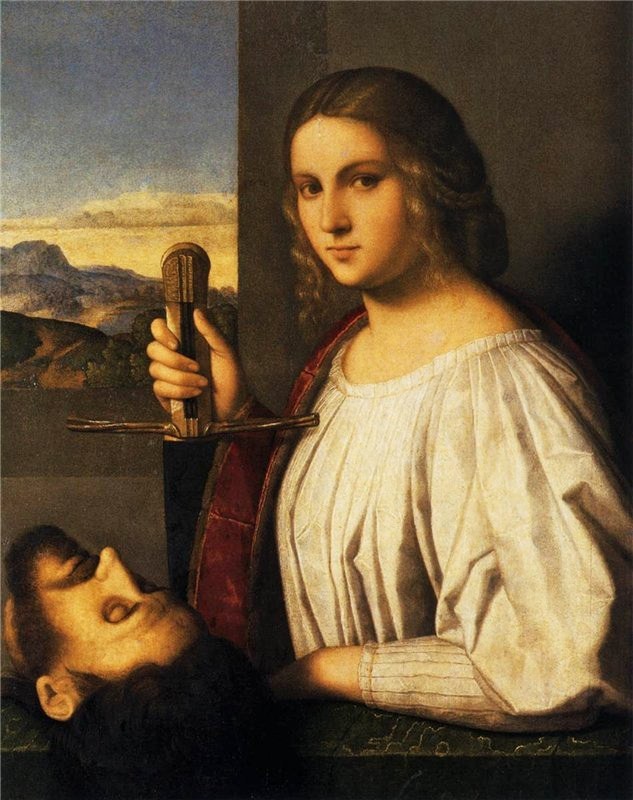
Image: Vincenzo Catena, Judith, 1520-30s, Fondazione Querini Stampalia, in the public domain from Wikimedia Commons